TL;DR: The Cognitive Gulf in AI Decision-Making
2026 Geopolitical Market Performance: The conflict triggered a massive energy shock, sending Brent Crude oil past $110 per barrel . During this time, the S&P 500 fell roughly $4.2%, while traditional safe havens like bonds failed to provide a hedge as yields rose alongside inflation .
Bitcoin’s Decoupling and Resilience: Despite an initial 7% dip when strikes began, Bitcoin staged a “redemption trade,” surging past $72,000 by mid-March while traditional equities remained mired in a technical breakdown .
Asset Class Uncorrelation: Bitcoin has emerged as a unique asset class with a negative correlation of -0.69 to gold in early 2026. While gold hedges against “ruin risk” and systemic fracture, Bitcoin functions as a “pressure valve” for global liquidity.
Historical Pattern of Maturity: Bitcoin has evolved from a niche experiment for tech enthusiasts in 2009 to a mature macro hedge in 2026, supported by over $62 billion in institutional Spot ETF inflows .
The “Secret Sauce” of Diversification: Modern Portfolio Theory (MPT) emphasizes that low or negative correlations are critical for reducing overall portfolio risk. Combining uncorrelated assets helps investors optimize their “Efficient Frontier”—maximizing returns for a specific level of risk.
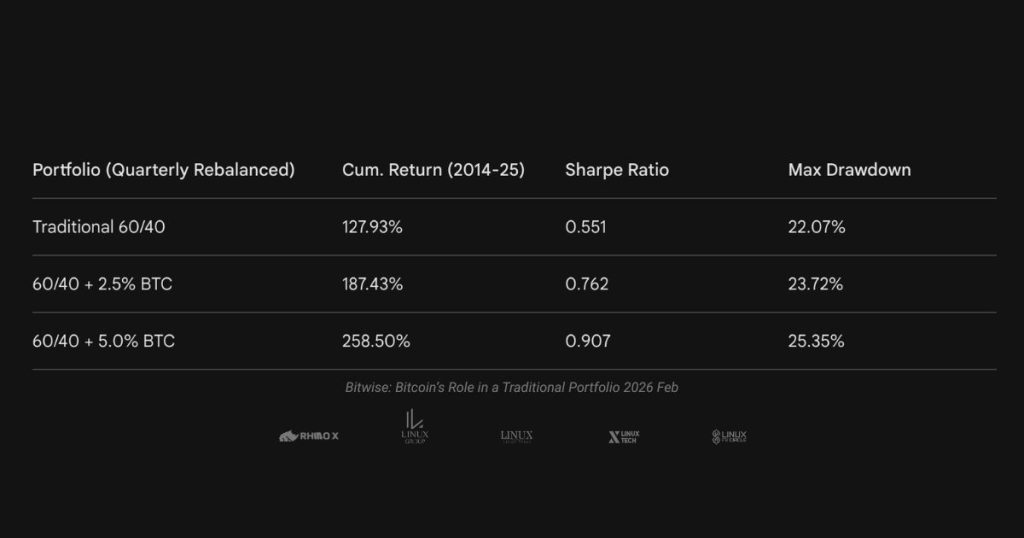
Enhancing the 60/40 Portfolio: Research indicates that adding a modest 5% allocation of digital assets to a traditional 60/40 portfolio raised annualized returns from 9.2% to 11.9% with only a marginal increase in risk.
The Rebalancing Premium: Regular rebalancing forces a disciplined “sell high, buy low” strategy, allowing investors to “harvest” volatility. Quarterly rebalancing with a 2.5% Bitcoin allocation has been shown to boost three-year risk-adjusted returns by 9 percentage points.
Bitcoin’s Role as an Uncorrelated Asset Class
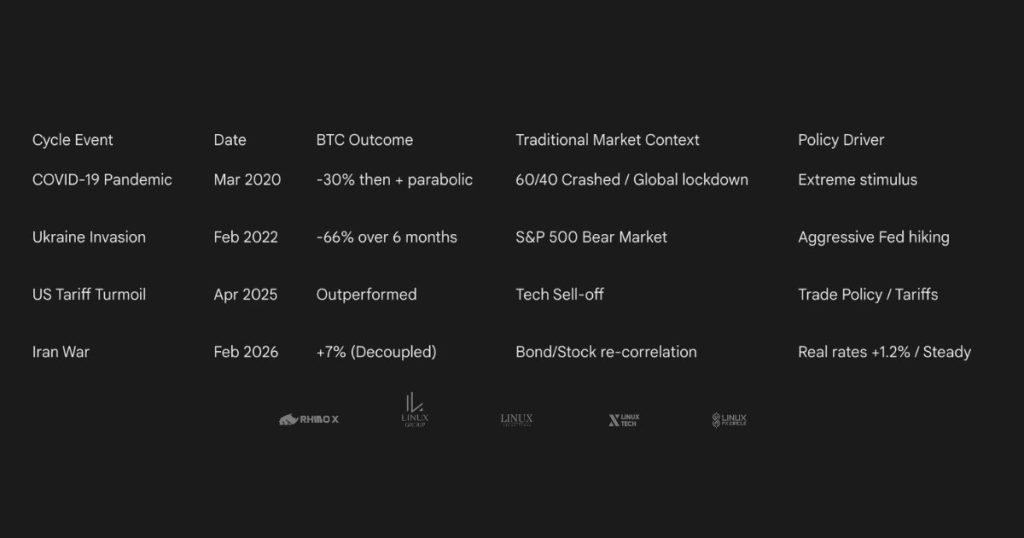
The most striking development of the 2026 Iranian conflict was the resilience and eventual decoupling of Bitcoin (BTC) from traditional risk assets. While Bitcoin initially took a hit alongside the broader market—plummeting 7% in the first six hours of the strikes—it staged a rapid redemption trade. By mid-March, Bitcoin had climbed over 7% to trade above $72,000, even as the S&P 500 remained mired in a technical breakdown.
The Mechanism of Decoupling
Bitcoin’s role as an uncorrelated asset class is defined by its ability to respond to stimuli distinct from those driving equities and fixed income. In the 2026 regime, this was driven by three primary mechanisms:
- Non-Sovereign Scarcity: As the conflict raised fears of currency debasement and stagflation, Bitcoin’s fixed supply became a powerful narrative, functioning as “digital gold with upside velocity”.
- Institutional Plumbing: The proliferation of spot Bitcoin ETFs — which saw total net inflows of over $62 billion by March 2026 — provided a structural floor. These vehicles allowed for 24/7 liquidity and institutional rebalancing, preventing the kind of retail panic-selling that characterized previous cycles.
- Real-Time Price Discovery: Because cryptocurrency markets never close, Bitcoin acted as a “pressure valve” for global liquidity during the weekends when traditional stock and bond markets were shuttered, allowing it to price in geopolitical risk more efficiently.
The correlation coefficient ($rho$) between Bitcoin and traditional assets underwent a significant shift during this period. Historically, Bitcoin often traded as a high-beta partner to tech stocks, with correlations reaching as high as 0.88-0.91 in late 2024. However, in early 2026, Bitcoin’s correlation with the Samp;P 500 dropped to 0.49, while its relationship with gold turned sharply negative at -0.69. This negative correlation with gold is particularly notable, suggesting that these two assets were responding to different facets of the crisis: gold to systemic fracture and ruin risk, and Bitcoin to global liquidity and the demand for non-sovereign stores of value.
Institutional Demand and On-Chain Resilience
Evidence from institutional-grade providers confirms that the 2026 rise was fueled by sophisticated capital. BlackRock’s Bitcoin Spot ETF (IBIT) recorded hundreds of millions of dollars in inflows during the height of the conflict, while long-term on-chain holders remained steadfast, with exchange balances failing to spike during the initial sell-off. This institutionalization has transformed Bitcoin’s volatility profile; while still high relative to equities, its realized volatility has consistently been lower than many mega-cap S&P 500 stocks, such as Netflix.
Historical Patterns: From Speculative Experiment to Macro Hedge
The 2026 Iranian conflict marks a maturation point in Bitcoin’s historical trajectory. To appreciate the significance of its current performance, one must compare it to previous “black swan” events and geopolitical shocks.
The Genesis and Early Speculative Eras (2009-2017)
Bitcoins early history was defined by its role as an experimental alternative to the traditional banking system following the 2008 financial crisis. Its initial value was derived from tech-savvy enthusiasts and libertarians seeking decentralized money. During this period, Bitcoin was almost entirely uncorrelated with traditional markets, largely because its market capitalization was too small to be integrated into institutional portfolios. It followed a strict four-year halving cycle, where supply shocks typically led to parabolic rallies (e.g., 2013 and 2017) followed by brutal crypto winters.
The 2020 Pandemic: The Liquidity Sponge
The COVID-19 pandemic of 2020 served as the first major macro test for Bitcoin. Initially, the asset behaved like a high-risk tech stock, plunging over 30% in March 2020 as global liquidity evaporated. However, the subsequent massive fiscal stimulus and monetary expansion by the Federal Reserve turned Bitcoin into a liquidity sponge. It rebounded sharply, surpassing its previous all-time highs by December 2020, as institutional players like MicroStrategy and Tesla began adding the asset to their corporate treasuries. This era marked the beginning of Bitcoins correlation with the $M2$ money supply and traditional risk assets.
The 2022 Ukraine War: The Inflationary Trap
The 2022 Russian invasion of Ukraine provided a sobering contrast to the 2026 Iranian conflict. On the day of the invasion, Bitcoin plummeted 8% and continued to bleed throughout the year, eventually losing 66% of its value by June 2022. The fundamental difference was the monetary environment: in 2022, the Federal Reserve was behind the curve, forced into an aggressive hiking cycle to combat 7.9% inflation. High real rates made a yield-free asset like Bitcoin deeply unattractive, and the market was further plagued by the idiosyncratic failures of the FTX exchange and the Terra/Luna ecosystem.
The 2024-2025 Transition: Institutionalization
The approval of spot Bitcoin ETFs in early 2024 fundamentally altered the markets plumbing. Bitcoin reached a new all-time high of $126,000 in October 2025 before entering a period of consolidated deleveraging. By the time the 2026 Iranian conflict began, Bitcoin had shed approximately 45% of its value from the peak, which many analysts viewed as an internal reset or leverage flush that left the market leaner and more resilient to the ensuing geopolitical shock.
Modern Portfolio Theory and the Importance of Low Correlation
Modern Portfolio Theory (MPT) suggests that investors should optimize their Efficient Frontier by combining assets with low or negative correlations to maximize returns for a given level of risk. In the 2026 conflict, Bitcoin’s low correlation with stocks (ρ = 0.49) and negative correlation with gold (ρ = -0.69) provided significant diversification benefits. This is essential because the traditional 60/40 portfolio has struggled as equity-bond correlations turn positive during inflationary shocks. Research indicates that adding a 5% digital asset allocation can boost annualized returns from 9.2% to 11.9% with minimal risk impact, as Bitcoins non-sovereign nature decouples it from traditional debt cycles.
The Concepts of Diversification and Rebalancing
While diversification reduces risk, rebalancing prevents portfolio drift, ensuring that surging assets like Bitcoin do not over-concentrate the portfolio. By systematically selling high and buying low, investors harvest a rebalancing premium from Bitcoins volatility. A Bitwise study showed that a 2.5% Bitcoin allocation with quarterly rebalancing boosted three-year risk-adjusted returns by 9 percentage points. This disciplined approach ensures that Bitcoins high volatility is managed to enhance overall stability and performance.
Conclusion
The 2026 Iranian conflict has functioned as a definitive laboratory for the digital gold thesis. By analyzing the performance of traditional assets during this energy-driven crisis, it is evident that gold and bonds provided only limited and inconsistent protection against the combined forces of inflation and dollar strength. Bitcoin, conversely, demonstrated a remarkable capacity for decoupling, staging a robust recovery and displaying a negative correlation with both equities and gold during the height of the volatility.
This performance is not an accident of history but the result of the assets structural evolution. The institutionalization of Bitcoin through ETFs, its inherent non-sovereign scarcity, and its role as a 24/7 liquidity pressure valve have transformed it into a credible uncorrelated asset class. When integrated into a diversified portfolio through disciplined rebalancing, Bitcoin has the potential to significantly enhance risk-adjusted returns and harvest the volatility of an increasingly unstable geopolitical landscape. As the global economy continues to grapple with the fallout of the 2026 conflict, the inclusion of digital assets is no longer a fringe experiment but a strategic imperative for resilient portfolio construction.
REFERENCES
- Bitcoins Role in a Traditional Portfolio – Bitwise Research
- Oil and Gold Take The Lead In 2026 So Far As Bitcoin Registers The Deepest Losses: Analysis – Crowdfund Insider / CoinGecko
- Balancing Risk and Return: Gold and Digital Assets in a 60-40 Portfolio – MSCI
- Bitcoin Price Spikes as Iran War Rages on and Investors Pile into Redemption Trade – DL News
- How Correlation Impacts Diversification: A Guide to Smarter Investing – Saxo Bank
- Modern Portfolio Theory: Pillar of Balanced Investing – Fincart
- Crypto in Diversified Portfolios – Grayscale Research
- Bitcoin and Gold Record Divergence – ByteTree Research
- Economic Impact of the 2026 Iran War – Wikipedia
- Bitcoin Beats Gold Amid US-Iran Conflict – MEXC News / BitMEX
DISCLAIMER
Past performance does not guarantee future results.
Opinions and estimates offered constitute our judgment and are subject to change without notice, as are statements of financial market trends, which are based on current market conditions. We believe the information provided here is reliable, but do not warrant its accuracy or completeness. This material is not intended as an offer or solicitation for the purchase or sale of any cryptocurrencies. The views and strategies described may not be suitable for all investors. This material has been prepared for informational purposes only, and is not intended to provide, and should not be relied on for, accounting, legal or tax advice. Any forecasts contained herein are for illustrative purposes only and are not to be relied upon as advice or interpreted as a recommendation.
©Linux Group, October 2024.
Unless otherwise stated, all data is as of October 7, 2024 or as of most recently available.

